Whenever the topic of Assamese dictionaries comes to mind, we remember the “হেমকোষ (Hemkosh)” dictionary compiled by Hem Chandra Barua. The first edition of this dictionary contained 22,346 words. The dictionary was published in 1900. Even before that, the American Baptist missionary Miles Bronson, with the encouragement of Jaduram Dekabarua, had composed an English-Assamese dictionary. This dictionary was published 33 years before “Hemkosh” was printed, in 1867. The specialty of this dictionary was that the included words were arranged according to pronunciation. Additional characters beyond the Assamese alphabet were omitted in the arrangement. The roots of the words were not determined. The number of words was very few.
The veil of illusion
The learned society of Assam does not need to be introduced to “Hemkosh” and Miles Bronson’s dictionary. Many call Miles Bronson’s dictionary the first dictionary of Assam and Hem Chandra Barua the first Assamese lexicographer. However, the first dictionary of Assam is not the English-Assamese dictionary compiled by Miles Bronson, nor is Hem Chandra Barua the first Assamese lexicographer. The first dictionary of Assam is the manuscript named “Amar Kakot Homüng ( 𑜒𑜦𑜡 𑜉𑜦𑜡 𑜍𑜦𑜡 𑜀𑜠𑜀𑜨𑜄𑜫 𑜑𑜦𑜡 𑜉𑜢𑜤𑜂𑜫 )” — meaning “The Eternal Document/Book from the Country of Palaces” — written on sachi pat (traditional Assamese writing material made from bark) by the Ahom scholar 𑜄𑜦𑜧 𑜂𑜩 𑜉𑜦𑜡 𑜑𑜤𑜂𑜫 / Tae-ngai Mo-hong (Tengai Mohan) in 1792, nearly a hundred years before “Hemkosh” was printed. The manuscript is also known as “Homüng ( 𑜑𑜦𑜡 𑜉𑜢𑜤𑜂𑜫 )” or “Bar Amra.” This dictionary, the first example of linguistic practice in the history of Assam, is still not widely studied in Assam’s academic circles. In this dictionary, Assamese synonyms and meanings of Ahom words are given. This dictionary can be called an Ahom-Assamese lexicon. The dictionary was written in the Ahom script.
 The “Homüng” manuscript
. Assam’s first Dictionary (not in Assamese script) — Amar Kakot Homüng (Language: Ahom-Assamese, Script: Ahom, Year: 1792).
. First ever comprehensive Assamese dictionary — Bronson’s A Dictionary of Assamese and English (Language: Assamese-English, Script: Assamese and English, Year: 1867).
. Assam’s first lexicographer — Tae-ngai Mo-hong (Tengai Mohan).
. Assam’s first lexicographer, who compiled a comprehensive Assamese dictionary — Hem Chandra Barua.
The ignored scholar
The author of the “Homüng” manuscript, Tengai Mohan, was a worthy son of the Dihingia Mohan clan. According to historical records, the scholar Tengai Mohan’s home was in the Tengapukhuri area of Charaideo district. The pond named Tengapukhuri was excavated in his name. He was born in 1715 during the reign of Siva Singha. During his lifetime, many kings and queens, including Siva Singha’s three queens — Bor roja Phuleshwari, Ambika, Sarveshwari — as well as Pramatta Singha, Rajeshwar Singha, Lakshmi Singha, Gaurinath Singha, Kamaleswar Singha, Chandrakanta Singha, Purandar Singha and others, sat on the throne. During this time, he witnessed many political events and domestic conflicts in the kingdom. Long-standing rebellions were ongoing in both Upper and Lower Assam for religious and socio-political reasons. The capital, Rangpur, was in turmoil. To suppress the long-standing rebellion, Gaurinath Singha finally had to seek help from the British East India Company based in West Bengal. Consequently, the Company’s representative, Captain Welsh, entered Assam with his army and suppressed the rebellion. During the time of Swargadeo Gaurinath Singha, the Moamoria rebellion caused significant damage and disrupted the rule and administration of the Ahoms. Because of this, Gaurinath Singha sought help from the British. Taking this opportunity, the British, intending to trade in Assam, signed a treaty with King Gaurinath Singha under the leadership of Captain Welsh. According to the treaty, the British completely suppressed the Moamoria rebellion and began trading in Assam.
 A portrait of Tae-ngai Mo-hong (Tengai Mohan) — collected from Nabin Buragohain’s the “Ahom Buranji Kokh”
It is also believed that once, while the British were transporting salt by boat along the Dikhou River for trade, they discovered a box of Tai manuscripts floating in the river and took it to England. Wanting to know the contents written in the manuscripts recovered from the river, the English searched for a Tai scholar. At that time, Purnananda Burhagohain knew well about the scholar Tengai Mohan, and around 1775, he arranged for him to be sent to distant England. There, for about 6 years, he not only studied the Tai language manuscripts but also taught the Tai language to the British and translated those into English, as he also had complete mastery over the English language. Staying in distant England for 6 years greatly expanded his knowledge. It is believed that he was the first Assamese person to travel to England (Bilat). However, there is no historical record proving that Tengai Mohan actually went to England; therefore, it may be considered a form of pseudo-history, similar to the name “Bamuni Konwar” attributed to the Ahom king Süw-dang-pha.
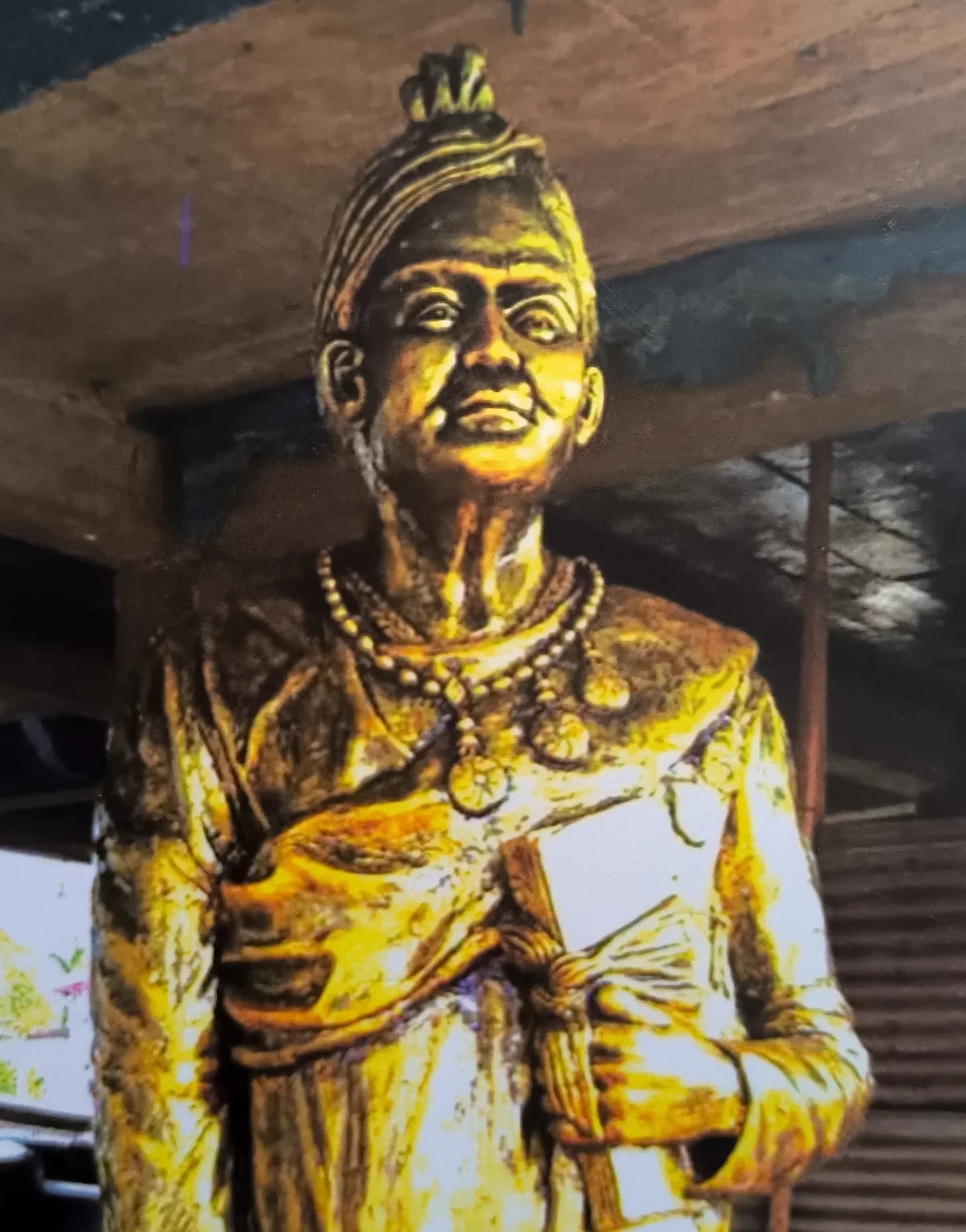
A statue of Tae-ngai Mo-hong (Tengai Mohan) Towards the end of Ahom rule, the lives of common people became uncertain due to political turmoil. Amidst such an unstable atmosphere, the thoughtful and farsighted Tengai Mohan silently continued his mission of collecting word meanings. He felt that the battle to be fought for the language and culture of the Ahom community was a thousand times greater than the battles fought for political gains and losses.
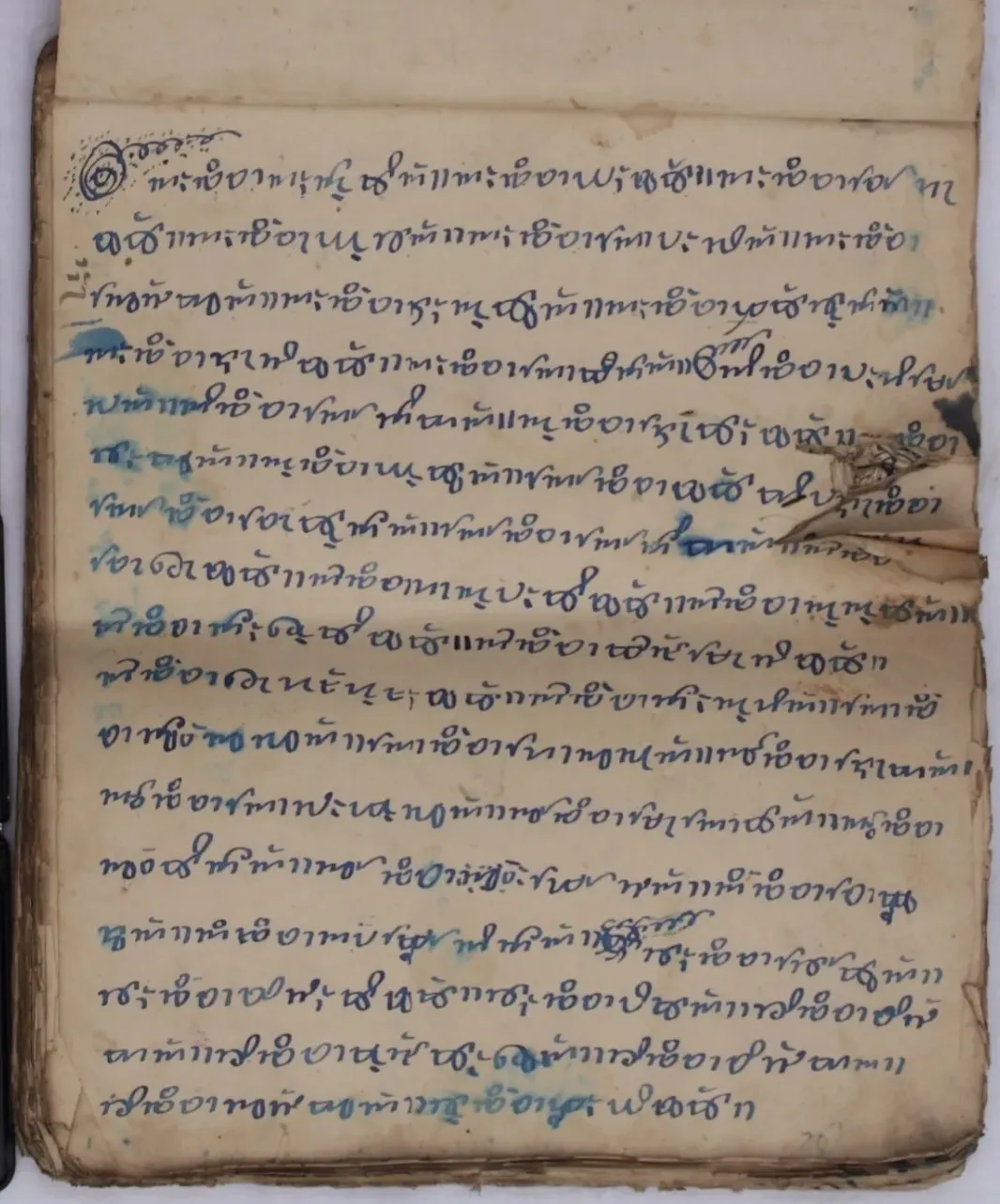
An old paper copy of “Homüng” manuscript
Even after Tengai Mohan’s dictionary was prepared, the period of political instability in Assam did not end. Due to internal political conflicts, the Burmese got an opportunity to invade Assam. People had to leave their homes and flee across the Dihing and Dikhow rivers. Along with property, the manuscripts preserved in families were lost or transferred. After the Treaty of Yandaboo, a stream of people from outside Assam flowed into Assam for employment and trade. Many people collected manuscripts written on sachi pat in the name of study and research. The manuscripts changed hands and were eventually lost. This lexicon, written by Tengai Mohan, was also lost for a short period of time. However, several other people from the “Mohan, Deodhai, Bailung” families had copied and preserved this manuscript. Later, Hem Chandra Goswami obtained this rare manuscript from a Bengali gentleman named Kailash Chandra Sen. Hem Chandra Goswami gave the manuscript to the Government of Assam. In 1964, the Department of Historical and Antiquarian Studies (DHAS) of the Government of Assam published it under the name “Ahom Lexicons” (along with “Lati Amra” — another dictionary published together with “Bar Amra”, composed by Ramakanta Molaigharia Boruah). In this lexicon, the English synonyms of the Ahom words written by Tengai Mohan and their pronunciation in the English-Assamese script were given.
The year Tengai Mohan compiled the dictionary
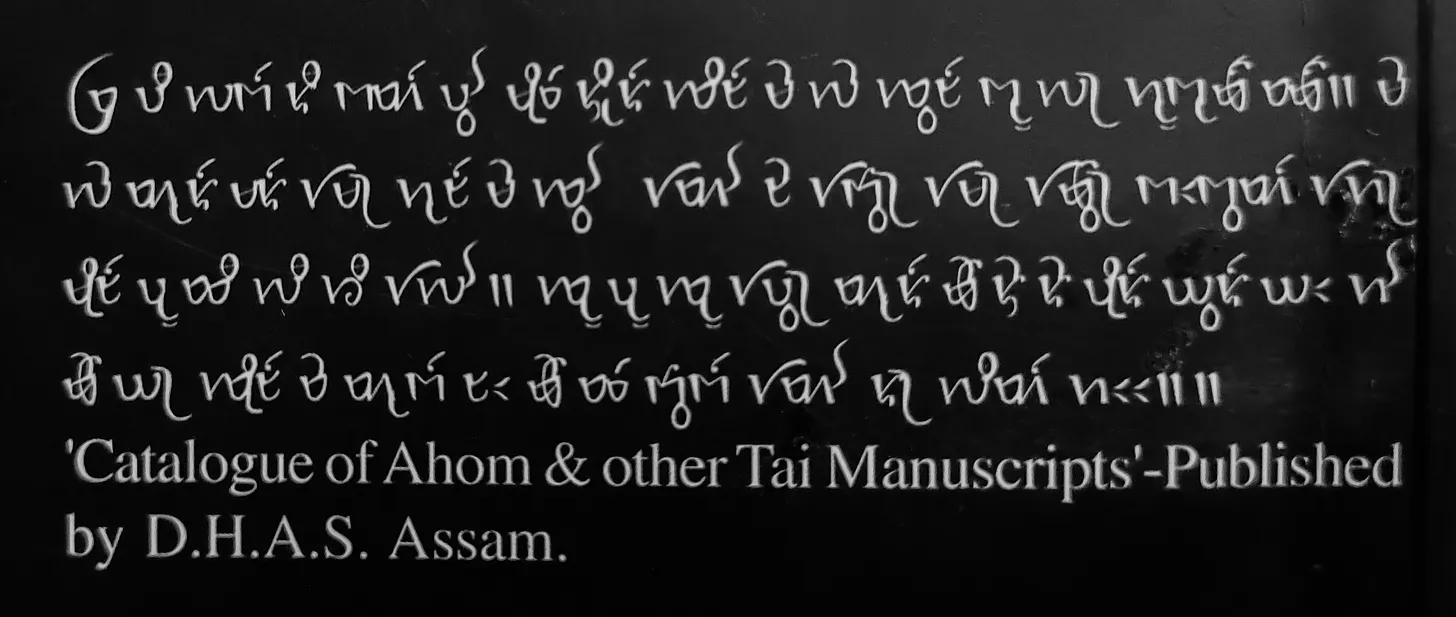
Catalogue of Ahom and other Tai Manuscripts In Ahom script — 𑜆𑜣 𑜎𑜀𑜫 𑜃𑜣 𑜀𑜄𑜫 𑜆𑜧𑜨 𑜉𑜢𑜤𑜰𑜫 𑜓𑜢𑜤𑜃𑜫 𑜋𑜢𑜂𑜫 𑜉𑜩 𑜎𑜩 𑜋𑜨𑜂𑜫 𑜀𑜥 𑜎𑜡 𑜑𑜥 𑜀𑜤𑜍𑜫 𑜈𑜍𑜫 𑜽 𑜉𑜩 𑜎𑜩 𑜄𑜤𑜃𑜫 𑜉𑜃𑜫 𑜉𑜦𑜡 𑜑𑜤𑜃𑜫 𑜉𑜩 𑜋𑜧𑜨 𑜄𑜦𑜧 𑜂𑜩 𑜒𑜦𑜡 𑜉𑜦𑜡 𑜍𑜦𑜡 𑜀𑜠𑜀𑜨𑜄𑜫 𑜑𑜦𑜡 𑜉𑜢𑜤𑜂𑜫 𑜆𑜥 𑜌𑜣 𑜎𑜣 𑜁𑜣 𑜎𑜦𑜧 𑜽 𑜋𑜥 𑜆𑜥 𑜋𑜥 𑜆𑜦𑜡 𑜄𑜤𑜃𑜫 𑜍𑜩 𑜓𑜩 𑜃𑜩 𑜆𑜢𑜤𑜃𑜫 𑜊𑜨𑜂𑜫 𑜊𑜠 𑜑𑜧 𑜍𑜩 𑜊𑜡 𑜋𑜢𑜤𑜂𑜫 𑜈𑜩 𑜄𑜤𑜀𑜫 𑜂𑜠 𑜍𑜩 𑜈𑜰𑜫 𑜒𑜨𑜀𑜫 𑜄𑜦𑜧 𑜃𑜡 𑜎𑜢𑜄𑜫 𑜑𑜠𑜠 𑜽𑜽
(Pee lak ni kat plau müw dün tseng mai lai tsowng kuu laa Huu-Kuur-War. Mai lai tun man Mo-hong Tae-ngai Aw-Maw-Raw Kakot Haw-Müng puu thee lee khee lae. Tsu puu tsu paw tun rai dai nai pün yowng ya hau rai yaa tsüng wai tuk nga rai bao awk tae naa lit oii).
Meaning — This year, in the 26th year of the Ahom calendar (which corresponds to the year 1792 in the English calendar), in the first month. On a Friday, according to the Hindu calendar, Tae-ngai Mo-hong, a descendant of the first branch of the Mohan clan (known today as the Dihingia Mohan), wrote the Amar Kakot Homüng manuscript. To forge a bright future, let this book endure and journey far. O God, and you, our ancestors who gave us life, bless us and this book from the spirit world.
The veil of ignorance
The Veil of Ignorance, a thought experiment proposed by the philosopher John Rawls, is designed to determine fair and just principles for organizing society. It asks individuals to imagine themselves in a hypothetical situation where they have no knowledge of their own social position, personal characteristics, or cultural background. Behind this “veil,” people are unaware of their race, gender, wealth, social status, culture, religion or even the structure of the society in which they will live. By removing self-interest and bias, the concept encourages individuals to design social rules based on impartiality and fairness. Thus, the Veil of Ignorance functions as a philosophical tool rather than a literal condition. While Rawls used it as a tool for justice, this concept can also explain the cultural erosion faced by a community.
The Ahoms, who arrived in Assam under their first monarch Süw-ka-pha, played a foundational role in the region’s history and identity. Today, however, their language, script, beliefs and customs are fading. Once the dominant force in Upper Assam, they now face marginalization — not through force, but through a “veil of ignorance” that has obscured their identity. This situation can be interpreted through a reversal of Rawls’s idea of the veil of ignorance. While Rawls imagined the veil as a mechanism that promotes fairness, in the Ahom context a historical “veil” has obscured elements of the community’s cultural memory. This very concept of a “veil” has contributed to their loss of culture, language, beliefs and even the modification of their actual history. Over time, they’ve come to adopt the mainstream Assamese culture as their own, losing touch with their distinct heritage. While Ahoms are integral to Assamese identity — indeed, that identity was shaped by them — it’s important to remember that “Assamese” is a state identity, not an ethnic one. As a result, many Ahoms today are familiar primarily with widely celebrated historical narratives of Süw-ka-pha, Lachet, Joymoti, Mulagabhoru etc. but know little of their ancestral language, beliefs, attire or true history.
This “veil” was not accidental. After the Treaty of Yandaboo (1826), the Ahoms were politically and socially sidelined by the British and dominant Assamese groups. Their language declined, and their history was rewritten to fit a caste Assamese narrative. The work of Tengai Mohan provides an important historical insight into this transition. His dictionary demonstrates that the Ahom language continued to be practiced within the community until the early nineteenth century. The decline of Ahom political power was accompanied by broader social and cultural transformations. As administrative structures changed and new linguistic and social hierarchies emerged under colonial rule, the use of the Tai Ahom language declined rapidly, eventually becoming largely ceremonial.
Historical interpretation has also played a role in shaping collective memory. In certain cases, narratives recorded in later sources differ from those preserved in Tai Ahom manuscripts. For example, the story of Süw-dang-pha is often presented as that of a ruler raised in a Brahmin household, whereas the original Tai manuscripts indicate that he was raised by a Dafala (Nyishi) tribal family. Such differences illustrate how historical narratives can evolve over time, sometimes diverging from earlier documentary traditions. Yet, this modified narrative persists, repeated even by modern scholars. Historical processes — particularly colonial transformations and later narrative construction — can gradually obscure elements of a community’s cultural heritage.
Tengai Mohan’s dictionary is another crucial example of this “veil of ignorance” effect. Although it is the first dictionary written in Assam, and Tengai Mohan is the first lexicographer from the region, it is still not recognized as Assam’s first dictionary. Credit has not been given to Tengai Mohan to this day, as mainstream academia ignores this fact. Tengai Mohan’s contribution has received relatively limited recognition in mainstream academic narratives. Consequently, even within the Ahom community today, awareness of this work and its historical importance remains minimal. Even people from his own birthplace know nothing of him.
All of this is because of the “veil of ignorance” that was drawn in front of the Ahom community centuries ago. Apart from the facts that have been accepted by mainstream academia, the current Ahom population knows nothing about their culture, language or their actual history as it is written in their own Tai manuscripts. This collective forgetting is the result of a centuries old “veil” — imposed, internalized and now complete.
The metaphor of a “veil of ignorance” therefore provides a useful lens for understanding how the Ahom community’s language, traditions and historical memory became partially marginalized over time.
The guiding light
Recovering and studying Tai Ahom manuscripts and other historical sources is thus essential for reconstructing a more complete and nuanced understanding of the Ahom past. Hem Chandra Barua’s “Hemkosh” dictionary is a national asset for Assam and Tengai Mohan’s “Homüng” dictionary is equally important. Just as Assam has a close relationship with Indian culture in terms of language and customs, it also shares a deep kinship with the languages and cultures of eastern countries like Thailand, Myanmar and China. In the flow of time, India has been compelled to adopt a “look-east policy” and later an “act-east policy”, instead of only looking towards the west, which is an example of this. Assam’s relationship with these eastern countries has existed since ancient times. Learning the Tai language has become essential for exchange with these countries. The Ahom language itself is a branch of the larger Tai language family. For learners of the Tai language, Tengai Mohan’s dictionary today serves as a guiding light.